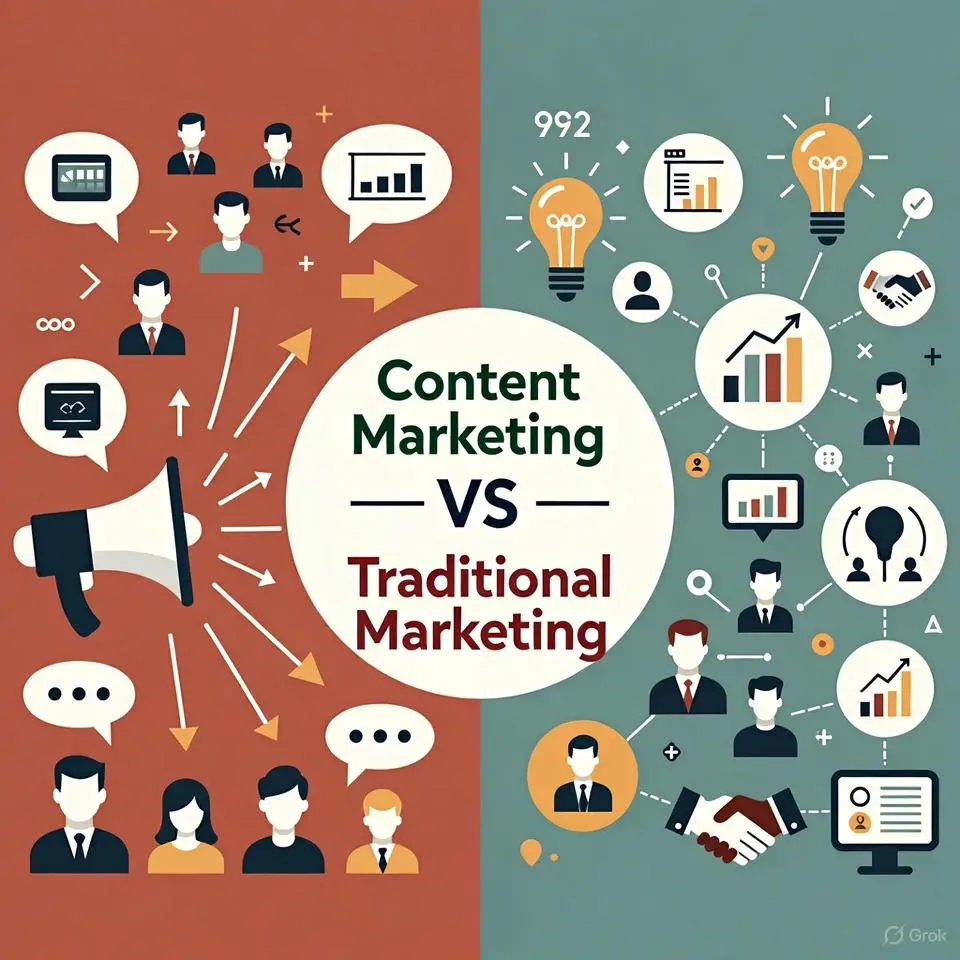
Content marketing and traditional marketing are two distinct approaches to promoting products or services. While traditional marketing focuses on directly selling, content marketing aims to build an environment, to sell the idea creating a connection of the product with the audience.
For example, a renowned tractor manufacturer instead of advertising its tractors chose to train farmers on how to increase per acre yield. A leading tyre manufacturer instead of marketing its tyres, spent its marketing budget on promoting countryside recreation. It first created demand indirectly and then catered to it.
There was a brilliant group of MBA graduates who helped companies to succeed. They operated with the name “The Innovators.”
Known for its expertise in the industrial sector, “The Innovators” sought to promote a new line of highly priced industrial equipment on behalf of a distribution company (say ESL). The distribution company faced the challenge of marketing expensive machines to the textile industry.
“The Innovators” recognized that traditional marketing alone would not be sufficient for this high-end equipment. Instead, they decided to employ a content marketing strategy that would not only showcase the capabilities of the machines but also perform environmental building.
“The Innovators” began by publishing case studies on the distribution company website, their newsletters, LinkedIn etc. Most of these articles were not directly related with the product but focused on image building of the distributor and the manufacturer it represented.
The product related articles explained how these machines could optimize production. By providing detailed technical specifications and real-world examples, “The Innovators” aimed to educate their audience about the value and potential of these machines.
To further enhance their content marketing efforts, “The Innovators” directed the distribution company to professionally solicit support of the industry experts and consultants who had firsthand experience of the industrial equipment. By including the endorsements of these experts in the company’s websites, articles etc., “The Innovators” aimed to build credibility among the target audience in the textile industry.
“The Innovators” also organised factory visits to the equipment manufacturer and its worldwide textile customers, held conferences and training seminars, where they invited textile owners and professionals. Relationship building was one of the main purposes.
One particular success story spearheaded by “The Innovators” was about a struggling textile company that was using outdated machinery and was on the verge of shutting down due to inefficiencies and high OPEX.
Through their content marketing efforts, “The Innovators” successfully helped to sell not only the high-end equipment to the ailing unit but also the solution of staying ahead in the competition.