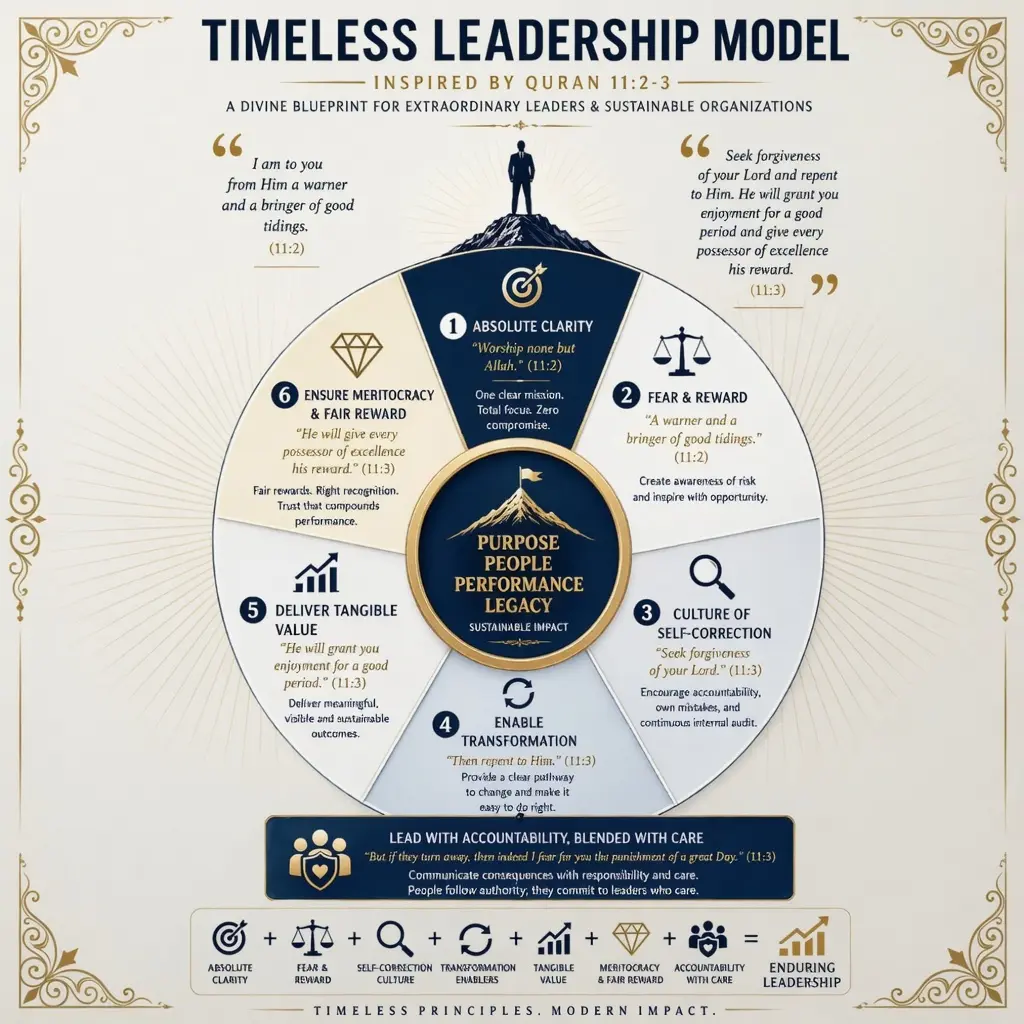
One of the most complete leadership models was presented centuries ago in the Qur’an (Surah Hūd 2–3). Its brilliance lies not only in spirituality, but in its precision of strategy, psychology, and governance.
Here is what it teaches us—at a C-suite level:
1. Absolute Clarity of Purpose
Great leadership begins with an uncompromising core. Not ten priorities. Not diluted ambition.
One clear mission that defines everything else.
Organizations that scale sustainably are those that eliminate noise and align relentlessly around a singular purpose.
2. Balance Fear and Reward
The model integrates two powerful drivers of human behavior:
Risk awareness (what happens if we fail)
Opportunity vision (what we gain if we succeed)
Most leaders over-do one at cost of the other. Exceptional leaders engineer both simultaneously—creating urgency without anxiety, ambition without illusion.
3. Build a Culture of Self-Correction
Before transformation comes acknowledgment.
High-performing organizations normalize:
Owning mistakes
Continuous internal audit
Course correction without ego
This is not weakness. This is institutional strength.
4. Enable Structured Transformation
Recognition alone is not enough.
Leaders must provide a clear pathway to change—systems, training, and strategic realignment that convert intent into execution.
5. Define Tangible Value Creation
People don’t commit to abstract promises.
They commit to visible, meaningful outcomes—growth, stability, opportunity.
The lesson: present value in a way that reinforces belief, not limits it.
6. Institutionalize Meritocracy
A high-performance culture rests on one non-negotiable principle:
Everyone gets what they have earned.
No opacity. No favoritism.
When fairness is visible, trust compounds—and so does performance.
7. Lead with Accountability—Blended with Care
True leadership does not rely on intimidation.
It communicates consequences with responsibility and concern.
The difference is subtle, but decisive:
People follow authority; they commit to leaders who care.
Executive Takeaway
The equation is simple, yet rare in execution:
Clarity + Balance + Self-Correction + Transformation + Fairness + Accountability = Enduring Leadership
In an era of complex markets and unpredictable environments, perhaps the most powerful advantage is not a new tool—but a timeless framework applied with discipline.
The question is not whether these principles work.
The question is whether we are prepared to lead at this level of clarity and integrity.