Young engineers often believe success belongs to those with more money, bigger factories, superior technology, or stronger connections.
History repeatedly proves otherwise.
The world rarely rewards people for possessing resources.
It rewards people for transforming resources.
Iron ore beneath the earth has little value. Turn it into steel and its value rises. Turn that steel into a vehicle and its value rises further. Turn that vehicle into an intelligent electric car and the value multiplies again.
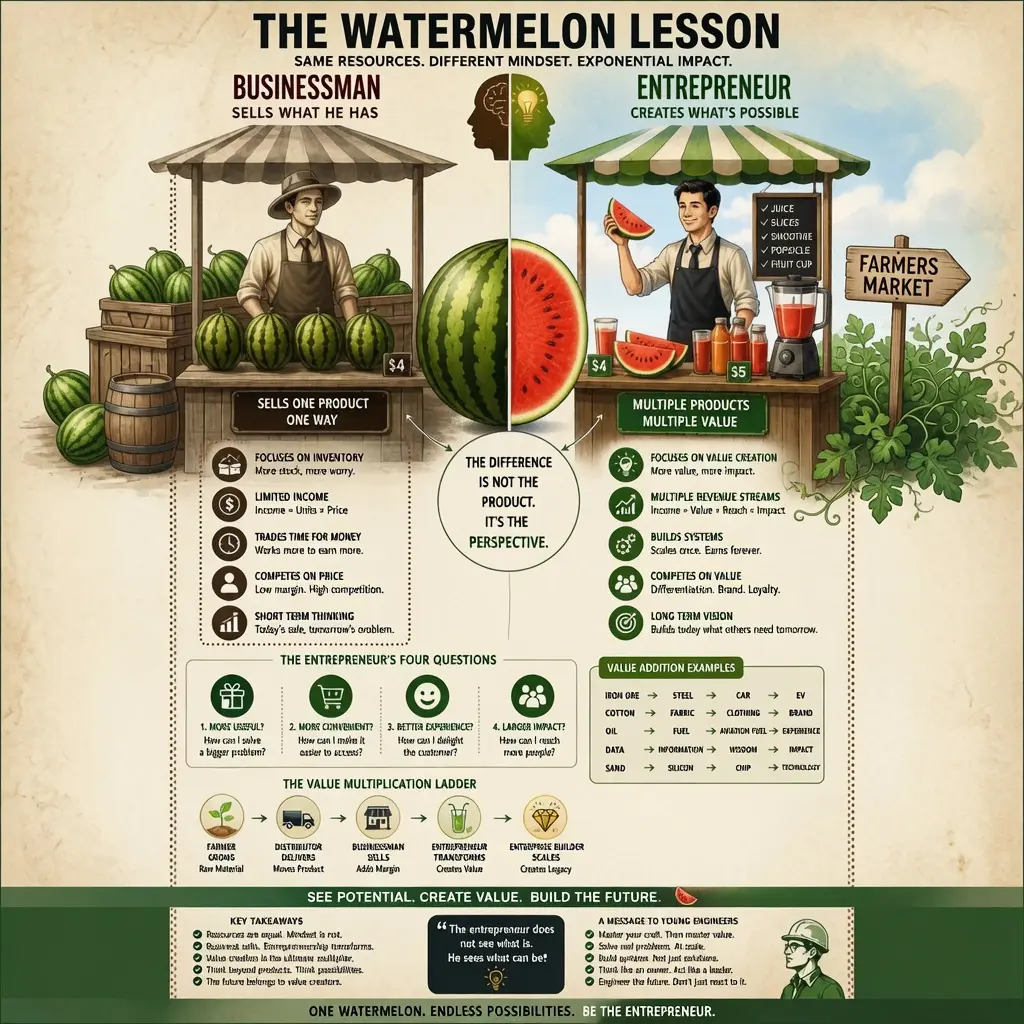
The entrepreneur’s genius is not in owning more watermelons.
It is in extracting more value from the same watermelon.
The picture quietly illustrates one of the most important economic principles ever discovered:
Wealth is not created by production alone.
Wealth is created by value addition.
The watermelon farmer grows.
The businessman distributes.
The entrepreneur transforms.
Each stage creates greater value than the previous one.
This is why crude oil is cheaper than aviation fuel.
Why raw cotton is cheaper than branded clothing.
Why information is cheaper than wisdom.
The future belongs to those who can identify opportunities for transformation.
The Entrepreneur’s Four Questions
Whenever entrepreneurs encounter a product, they instinctively ask:
1. Can I make this more useful?
The watermelon becomes juice.
2. Can I make it more convenient?
Customers no longer need to carry an entire watermelon home.
3. Can I improve the experience?
Freshly blended juice provides instant satisfaction.
4. Can I serve more customers?
Children, office workers, travelers, and health-conscious consumers may prefer juice over whole fruit.
These four questions have built some of the largest companies in history.
The Age of Commodities Is Over
People do not merely buy coffee.
They buy atmosphere.
They do not merely buy phones.
They buy all-in-one experience.
They do not merely buy transportation.
They buy convenience.
The entrepreneur understands that customers are rarely purchasing a product.
They are purchasing a problem solved, a desire fulfilled, or an experience improved.
Do not only solve technical problems.
Solve economic problems.
Technical excellence may earn you a career.
Commercial imagination may build an empire.
The Watermelon Principle
Every industry contains watermelons.
Unused opportunities.
Untapped value.
Invisible possibilities.
Most people see products.
A few see potential.
Most people sell what exists.
A few create what does not yet exist.
Most people ask, “What is this?”
Entrepreneurs ask, “What could this become?”
That single question separates ordinary commerce from extraordinary enterprise.